Páginas

Sunday, September 22, 2013

They way I like to read

Yesterday, after a nice talk with a friend about the different types of books available I decided to write a little post about the way I like to read them. However, it is important to clarify that this post is not dedicated to describe the most comfortable way to sit in order to read (which, btw, is one of the hardest things to find in this world), this post is rather to describe the sort-of-algorithm that describes the way I like to organize my readings.


The image above is just a snapshot of the little library of my study. There you can tell titles as diverse as Pocker for Dummies, Simon Bolivar, HP48G User Manual, Essay about Blindness, Lonely Planet Middle East, and History of Rock (just to mention some). This image is then powerful enough to expose the fact that there are plenty of types of books available for reading. Therefore I consider that it is important to have clear the personal priorities about own taste and preferences.

Personally, I tend to divide them into 4 categories: (1) Literature (2) Curiosity (3) History (4) Not-for-reading or Reference.

The categories number (1) and (3) are self explanatory. Then let's elaborate on (2) and (4). About (2) Curiosity, I could say that are those books that are explaining interesting science experiments, or fun management theories, or that are in general informative, easy to digest and fun. About (4) Not-for-reading or Reference, are those like travel guide books or technical stuff.

The most refined of all those are without any doubt (1) Literature, and more in my particular case that I like to read classics. Hence I consider it is not convenient to read two literature books in a row, as the perception of one might influence the perception of the second one. I use to put the example the situation of buying colognes: It is not fare to smell two colognes in a row, it is suggested to smell coffee in between.

Something similar is what I do with books, as far as I can, I like to read a book type (2) or (3) between each type (1). Happily I have a Kindle again, where it is very easy to get super interesting Curiosity and History books.

Saturday, September 21, 2013

Es la vida y nada mas ...

 La Peste - Albert Camus

Es el segundo libro que leo de Albert Camus, el primero fue El Extranjero, que justamente leí cuando comenzaba mi carrera universitaria, situación opuesta a la actual: el final de mi maestria.

Como siempre digo, estos resumenes mios no son criticas ni analisis del libro, por eso tiendo a poner una foto con el resumen que trae el librito por detras.
Tengo que admitir que me tomó mucho tiempo leer la primera mitad (como dos meses), mientras que la segunda mitad salió en una semana (justo el tiempo que tengo mi nuevo Kindle).

Aunque lo termine hace unos pocos minutos me encuentro corto de adjetivos o depronto tengo tantos que no se como sacarlos.

La falta de continuidad en la primera mitad del libro sin duda influye en la dificultad que encuentro para hablar de él y en no tener una calificación contundente, le doy entre un 3.5 y un 4. ¿lo recomendaría? sí, pero me reservo el derecho.

Es un libro de Post-Guerra (1947) y creo que eso hace que el autor presente unas partes existencialmente fuertes, puntos de vista a cerca de la religion, la actitud hacia la vida, las condenas a muerte, las razones para las guerras, el pudor y la desinformacion.
Personalmente esas partes me hacian pensar que La peste y la ciudad de Orán (donde todo sucede) no se referian más que a la guerra, el mundo entero y los tiempos modernos. El modo de vivir de todos ahi, sentía que podía ser mapeado a muchas de las actitudes modernas.

Un libro que hace reflexionar, hace pensar que esa peste es simplemente una caricatura de la vida misma, asi como uno de los personajes lo dice al final:

Pero la cosa es así. Los otros dicen: "Es la peste, ha habido peste." Por poco piden que les den una condecoración. Pero, ¿qué quiere decir la peste? Es la vida y nada más.

De igual forma el libro cierra recordando (¿profetizando?) que a pesar de la felicidad de la gente despues de la peste, todos olvidaban que la historia ha mostrado que la peste no muere, simplemente duerme y que puede llegar el dia que despierte de nuevo.

Highlights (Gracias al Kindle de nuevo :) )

La peste (Albert Camus)
quería contarle al doctor Rieux cómo durante todo este tiempo había en cierto modo olvidado a su mujer para entregarse enteramente a buscar una brecha en el muro que lo separaba de ella.
==========
—Sobre el valor. Bien sé que el hombre es capaz de acciones grandes, pero si no es capaz de un gran sentimiento no me interesa.
==========
Así, durante semanas y semanas, los prisioneros de la peste se debatieron como pudieron. Y algunos de ellos, como Rambert, llegaron incluso a imaginar que seguían siendo hombres libres, que podían escoger.
==========
Pero, de hecho, se podía decir en ese momento, a mediados del mes de agosto, que la peste lo había envuelto todo. Ya no había destinos individuales, sino una historia colectiva que era la peste y sentimientos compartidos por todo el mundo.
==========
Las familias pobres se encontraban, así, en una situación muy penosa, mientras que las familias ricas no carecían casi de nada. Aunque la peste, por la imparcialidad eficiente que usaba en su ministerio, hubiera debido afirmar el sentido de igualdad en nuestros conciudadanos, el juego natural de los egoísmos hacía que, por el contrario, agravase más en el corazón de los hombres el sentimiento de la injusticia. 
==========
"Pero lo peor —escribía Tarrou— es que están olvidados y lo saben. Los que los conocen los han olvidado porque están pensando en otra cosa y esto es comprensible. Los que los quieren los han olvidado también porque tienen que ocuparse de gestiones y proyectos para hacerlos salir. Esto también es normal. Y en fin de cuentas, uno ve que nadie es capaz de pensar realmente en nadie, ni siquiera durante la mayor de las desgracias. Pues pensar realmente en alguien es pensar minuto tras minuto, sin distraerse con nada, ni con los cuidados de la casa, ni con la mosca que vuela, ni con las comidas, ni con las picazones. Pero siempre hay moscas y picazones. Por esto la vida es tan difícil de vivir, y ellos lo saben bien."
==========
El sueño de los hombres es más sagrado que la vida para los apestados. No se debe impedir que duerman las buenas gentes. Sería de mal gusto: el buen gusto consiste en no insistir, todo el mundo lo sabe.
==========
He oído tantos razonamientos que han estado a punto de hacerme perder la cabeza y que se la han hecho perder a tantos otros, para obligarle a uno a consentir en el asesinato, que he llegado a comprender que todas las desgracias de los hombres provienen de no hablar claro. Entonces he tomado el partido de hablar y obrar claramente, para ponerme en buen camino. Así que afirmo que hay plagas y víctimas, y nada más.
==========
—Es posible —respondió el doctor—, pero, sabe usted, yo me siento más solidario con los vencidos que con los santos. No tengo afición al heroísmo ni a la santidad. Lo que me interesa es ser hombre.
==========
Pero la cosa es así. Los otros dicen: "Es la peste, ha habido peste." Por poco piden que les den una condecoración. Pero, ¿qué quiere decir la peste? Es la vida y nada más.
==========

Tuesday, August 20, 2013

Exactly two years later...

Two years ago, 21st of August of 2011 while I was reading The Old Man and The Sea I took a train that was going to take me from Geneva to Grenoble, a train that was going to take me back into the academic life, a train that was going to drop me in a new stage of my life: a Master degree.

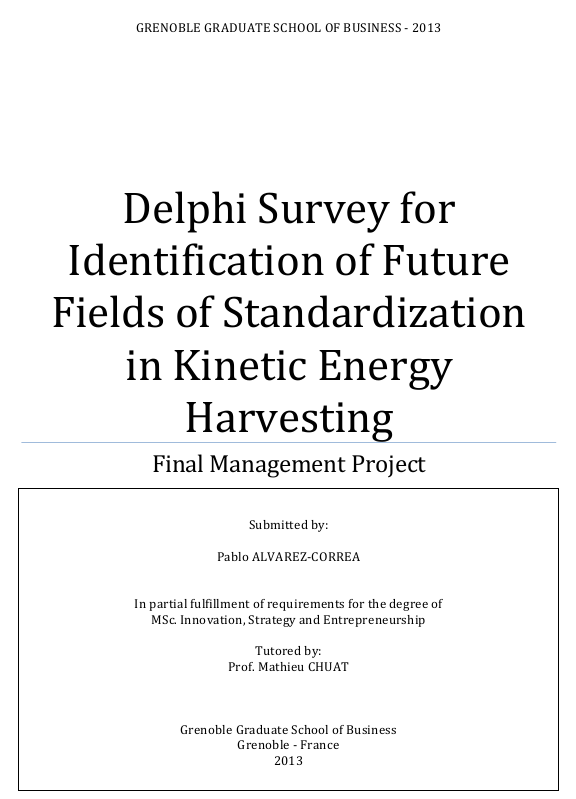
Today, two years later,  20th of August of 2013 I have the pleasure to declare that this stage of my life is closed. I have finished all my duties regarding the MSc Innovation, Strategy and Entrepreneurship as I completed my Final Management Project, a.k.a Dissertation or Thesis three days before of my personal deadline. Below you can see the cover page.


More details about the dissertation itself and about that stage of my life will come later, although for the time being I can summarize it as: EXCELLENT!

I would like to close this post and this chapter of my life with the credits and acknowledgments I offered at the end of my dissertation:

"It would not be fare to finalize this work without presenting my sincere thanks to all of those who participated in this research and to those who made from the last two years an unforgettable period of my life.

To Mathieu Chuat for his time, for his always kind guidance, feedbacks and remarks tutoring this project. His experience in technology and innovation management were extremely important in the development of this study. I am glad I had the chance to have him both as teacher and as tutor of this project, where I could appreciate his insights and vision about innovations.

To all the experts who accepted and participated into this Delphi forecast: Mr. Roy Freeland, Mr. Aaron Lemieux, Mr. Michael Perrotta, Mr. Jean-Frederic Martin, Mr. Brad Chisum, Dr. Jan Kunzmann, Prof. Alex Weddell, Prof. Libor Rufer.

I want to present my special thanks to Mr. Fabrice Poulin. Not only for his active participation
during the research, but also for giving me the amazing opportunity to make part of his organization (Infinergia Consulting) during my internship. There, I had the chance to learn about consulting in technology and to learn about Energy Harvesting. To him my most sincere thanks.

To all professors during my classes in GGSB particularly those who challenged my points of view
and woke up my passion for innovation management: Prof. Michele Coletti, Prof. Edward Roche, Prof. Jose Gotzsch, Prof. Isabelle Chaboud, Prof. Mark Esposito, Prof. Federico Pigni and Prof. Paolo Saviotti. From GGSB I also want to thank Marie-France Derderrian for facilitating the MSc ISE degree and to Emilie Personnaz for her endless kindness, support and willingness to help in any management issue of students.

I want to thank Beca Desafios and COLFUTURO for granting me the scholarships and providing
me the economic support, without which my last two years of study would had been impossible.

This work is dedicated to my mother and brother whose unconditional love, support and encouragement have brought me where I am right now. You both are the lighthouses of my life.

To my friends and classmates for making the most of the year we spent together, for resisting my  working style and for the endless laughs and memorable moments. To Alex, Guillermo, Agostino, Nick, Jose Manuel, Alejandra, Aparna, Din, Mohammad-Joud, Marlotte, Ioanna Yiasemi, Keegan, Zackis, Amit, Kabir, Julian, Clement. To all of you eternal thanks!"

Infinite thanks to all of them!

Sunday, August 18, 2013

2 years without Magyarország

Tomorrow it will be 2 years since I left Budapest. A city that changed my life and that will always be in my heart and memories. I just had it in my mind today and I couldn't help myself from listening to some magyar music, here, my two favorite hungarian songs

"8 hours of work, 8 hours of rest and 8 hours of partying!"


Palinka Sunrise


Sunday, August 11, 2013

Take care with what you read

It felt weird these days when I started taking decisions as if I was part of the plot of several books I have read, as if I was on the book and I knew the final and I had still a chance to change it.

Feeling at the same time like as Raskolnikov knocking at the door, or as Harry Heller getting an invitation to visit "the hell" or as old Govinda listening at old Sidhartha at the side of the river...I felt illuminated, but confused too.
It was weird to feel that Raskolnikov crossed the door, and although killed the old woman did not kill her sister, or that the wolf took power of Harry Heller and made him leave the dance-floor after joining Herminda shortly in "the hell"...or that indeed Sidhartha talks to you but not at the end of his life, but just when he is young and when he is getting to know Kamala.

It was weird to feel that my Steppenwolf took a decision based on fear about a possible punishment in Siberia, but ended up acting different thanks to a suggestion that Sidhartha gave me while crossing the river on his boat...

Whatever I have done or not, the conclusion is; Take care of what you read, for good or for bad, your life might end up on the books, on several of them at the same time!